
After Gorton. Where Now?
Labour must learn to be radical - on housing, defence, nationalisation and fighting the far right. We're in a crisis of democracy: start acting like it.

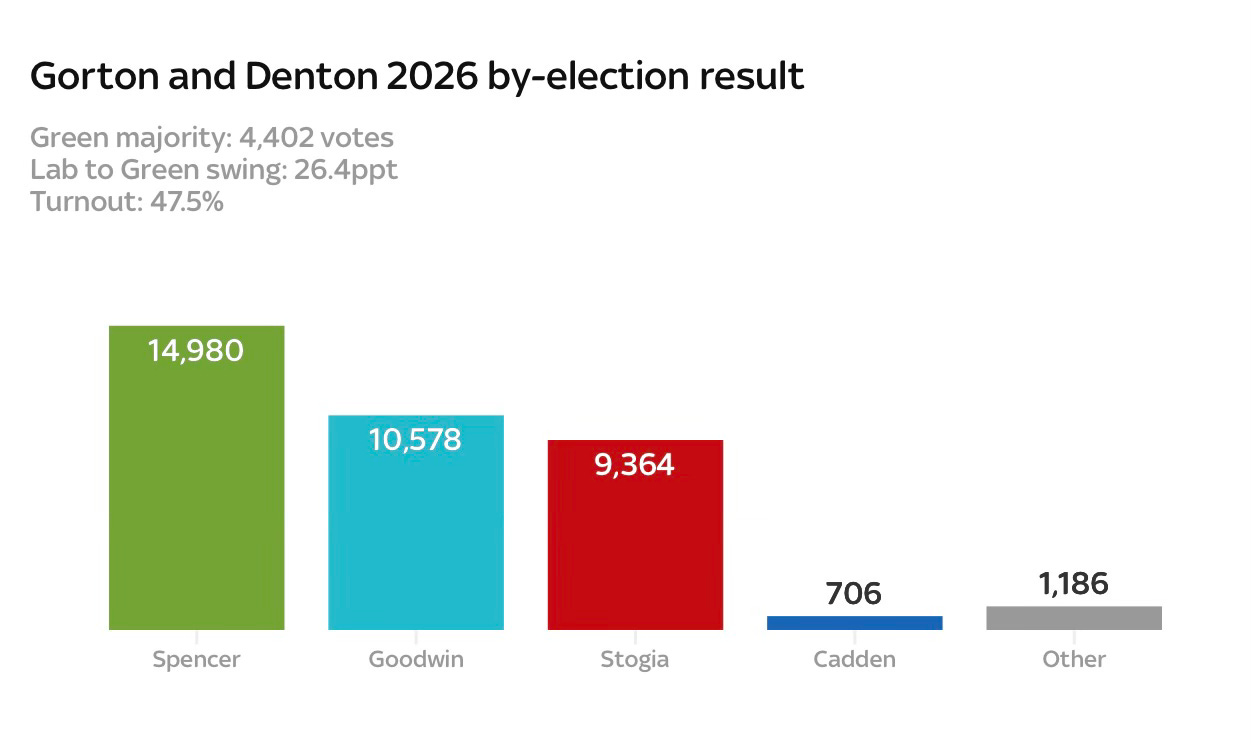
The result of the Gorton and Denton by-election is bad for Labour and not brilliant for the state of our democracy.
We have to remember this was a by-election caused by an MP who disgraced the party and then resigned, timing his resignation to enable the return of Andy Burnham, which the Labour NEC then blocked.
Plus it comes on the heels of the Mandelson scandal, which Keir Starmer has survived at the cost of a clear out of staff in Downing Street, including his political strategist Morgan McSweeney.
But from this extraordinary result, in a constituency with unusual demographics, we can draw the following conclusions:
The majority of people who live in cities reject Reform and its racism, and they will vote in 2029 for the progressive party best placed to stop them.
That’s what the high turnout meant: 25,000 people came out in the rain to reject Reform, which could only score fewer than 10,000.
Unfortunately, voters who live in small, de-industrialised towns and suburbs are still putting Reform top of the national polling. That means, to win an election in 2029, Labour has to become the party of beating Reform.
That, in turn, means delivering on its promise to keep economic migration to sustainable numbers, ending the housing of aslyum seekers in hotels and “smashing the gangs”.
And on top of that delivering on the issues voters are worried about: from NHS waiting times to anti-social behaviour to potholes in the roads.
In the cities, and in a straight fight for the degree-educated salariat, Labour is still winning - though the Greens, as elsewhere in Europe, are on the rise.
But what tipped the balance in Gorton and Denton was the swing by Muslim voters to the Greens - which the Green leadership has courted with blatant sectarian imagery, identifying Starmer with both Netanyahu and the Hindu nationalist leader Narendra Modi.
It’s not true that the whole Muslim community there voted Green: Labour has strong roots in that community and was able to mobilise them. But a combination of left-leaning discontent with Labour, sectarian rhetoric and disillusion over the Andy Burnham issue turned enough people off that, when it came to the question: how do we keep Reform out?, the Greens looked a better bet.
Something now has to change for Labour - but I do not think it is the leadership.
Though there was a surprise budget surplus last month, the UK’s borrowing costs are the highest in the G7 and would spike to unsustainable levels if there were political chaos.
We do not need a left-vs-right battle in Labour right now, with untested and inexperienced contenders vying for the job of leading a country under a hail of hybrid warfare attacks by Russia, and whose fiscal crediblity has to be maintained.
We need a return to dynamism in the Labour political project, which is to deliver investment-led growth, fix public services, win back consent for migration and asylum rights, and defeat the far right.
Paradoxically, Labour is delivering incremental gains: the migration figures yesterday were all moving in the right direction. NHS waiting times are falling and patient satisfaction with GP services is rising. It has delivered the biggest package of workers rights for two decades, new rights for renters and has bailed out the special educational needs system to the tune of billions.
But the narrative never lands. In part because Starmer is a poor communicator in an age of soundbites and social media. But mainly because all the big things Labour needs to do are blocked by its self-imposed fiscal rules.
We need to rearm fast to meet the Russian threat. If we did so it would create tens of thousands of jobs and investment boom - but the Treasury has been blocking the Defence Investment Plan for months.
We need to build social and council housing fast. But even after slicing away red tape it’s not happening fast enough: housing completions were 9% lower in 2025 than in 2024. Though planning applications are rising, there are 1.3 million people on housing waiting lists, while councils built just ten thousand homes last year.
The obvious solution is, as in the post-war era, a state-funded drive to build council homes. But again, the Treasury stands in the way: many councils are so cash strapped they can barely keep basic services functioning.
As for the cost of living, the number one concern of most voters, Labour has refused to cap rents, and refused to nationalise failing water companies that are still creaming profits off a dilapidated system.
There is a solution: to be boldly socialist on economics, proudly patriotic on defence and to solidify the centre against the ugly rhetoric of the far right.
What stands in the way of delivery on housing, public services, defence and the aspirations of Labour’s working class base are two things: a residual obsession with “market” solutions inherited from Blairism, and the Office for Budget Responsibility.
Having inherited this broken institution from the Tories, Rachel Reeves mistakenly strengthened the OBR’s hand on coming to power.
The problem is simple: Reeves’ entire strategy is focused on investment led growth. But the OBR does not believe this is possible. So whenever she borrows to invest, it calculates the overall impact will be minimal. The markets, seeing the obvious dysfunction, charge us a premium to borrow.
Of all the dysfunctions - the appalling comms, the abysmal decision to appoint Mandelson, the delays to defence spending, the mis-steps on Gaza - it is the failure to sort out this fundamental one that prevents Labour delivering on its promise of July 2024.
There’ll be all kinds of recriminations today over Gorton and Denton but, as I said at the start, it’s an unusual seat. To learn the right lessons you have to understand that, though they were beaten by the progressive vote in Manchester, Reform remain the strategic problem.
Labour has to remain laser focused on maintaining social consent for a multi-cultural and multi-religous society - which is fraying under the impact of global far right interference and disinformation campaigns.
That means managing migration, telling a story of hope and strengthening the online harms legislation to crack down on the lie-mongers and trolls.
In the coming months I hope we’ll see a split in the Green Party, as a mixture of Islamic conservatives and ultra-left antisemites force it to become explicitly “anti-Zionist”. It should be no surprise to see this rising within the Green tradition - elsewhere in Europe there’s a long history of mixing “nature politics” with far right tropes - and the Greens are attracting people who think broadly “left” but have no roots in class politics.
So I don’t think this puts the Greens on a roll nationally, but rather in a crisis of identity.
As for Labour, McSweeney is gone from Downing Street but he understood that, for Labour to win an election, it has to mobilise both the progressive vote in cities like Manchester, together with enough socially conservative working class votes everywhere else.
It’s a challenge social democracy has never faced before - and the fragmentation of the left vote into expressions of “values” rather than class interest is happening all over the world.
Rather than complaining about it, you have to build a new coalition to defeat the right and face down the religious sectarians.
If you want to recriminate - focus on what’s important: Labour came to power without much of a plan, floundered in the face of civil service obduracy, tied its own hands with the Budget Responsibility Act, picked needless fights with the soft left of the PLP, made stupid decisions to accept gifts from rich people and have communicated like amateurs.
Facing a crisis of belief in the institutions of government, that’s made things worse. Now we have to make things better.
I have no doubt Labour can win back Gorton and Denton in a General Election, and indeed win power again in 2029. In that year the right will be split between Reform and the Tories; the task will be to prevent the progressive majority splintering - which means starting now to raise the idea of tactical voting.
This may not be the nadir for Keir Starmer. The May elections may see better results for Labour, but in Wales, Scotland and London they will come under pressure from nationalists and the Greens. The best thing he can do is get on and govern.
What needs to change is the story, the people Labour chooses to tell it, the urgency for change, and the ridiculous blocking institution of the OBR has to be removed: either its rules are changed or its leadership goes or it is scrapped.
The most basic thing a government should do when faced with creaking infrastructure, high housing need and the unavoidable task of rearmament is borrow to invest.
The last thing I’ll say in response to the Gorton and Denton result is: move fast. Labour’s leading voices need to start thinking politically about strategy, not reeling from crisis to crisis.
This is a situation that wasn’t in the textbook of people brought up in the Blair era. It’s a global crisis of democracy and it was demonstrated, before our eyes, on the streets of Manchester all month.
You don’t solve it with factional intrigue or platitudes from the Tony Blair playbook. You meet crisis with radical action and narrative certainty.
This is unpaywalled - please share and subscribe. Thank you for reading