
Cognitive Warfare: A Primer
Why the concept should move centre-stage in UK national security debates

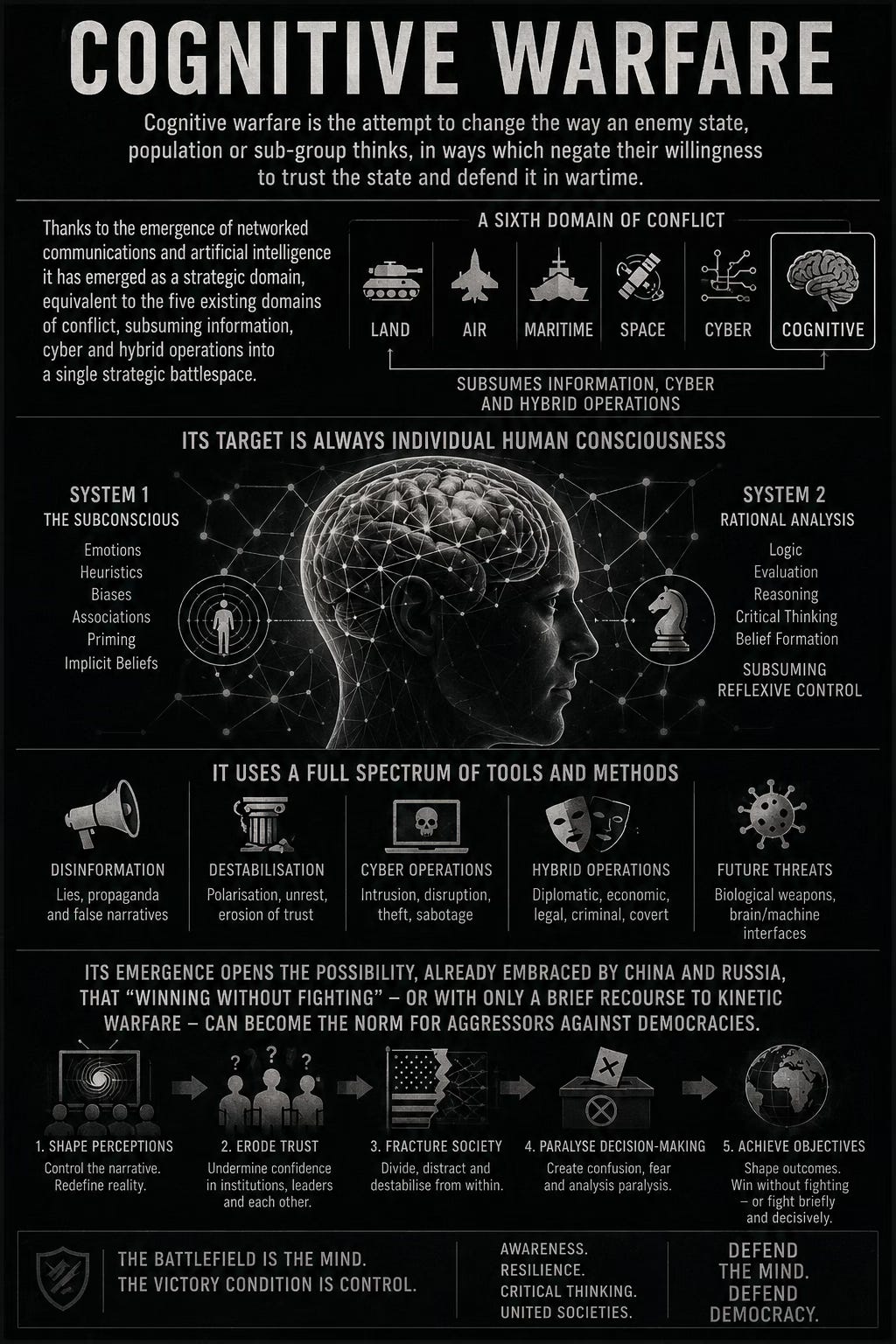
The next few issues of Conflict & Democracy will focus on the relatively new concept of Cognitive Warfare. I will argue that it has to replace “hybrid” in British strategic thinking, subsume information and psychological operations, and bring cognitive strategy into the heart of the civilian institutions of government.
This article serves as a primer in the concept: a history, lexicon and a proposed definition (to compete with about 100 others!).
History of a Concept
In the 1970s the Soviet military developed the doctrine of “reflexive control”, using information operations to distract, overload, paralyse and exhaust the enemy, to the point where he starts thinking in ways favourable to your own logic.
In 2013 the Russian general Valery Gerasimov proposed that a mixture of kinetic and information operations can rapidly collapse a state and destroy its population’s willingness to fight. Since then, the collective West has coined various terms to describe this new way of war.
“New Generation Warfare” was a label invented and discarded by analyst Mark Galeoitti. “Hybrid” entered NATO’s lexicon in 2014, both in response to the Gerasimov article and to its application in Crimea, and is now firmly embedded in the Alliance’s military doctrine.
But the hybrid concept, sometimes popularised as “greyzone” warfare, sees the non-military means - disinformation, cyber-attacks, economic pressure, deployment of irregular armed groups etc – as adjuncts to kinetic warfare: the phase of “shaping the battlefield” before the coup de main. It is a concept fitted to the operational level of armed conflict rather than strategy.
The Cognitive Warfare concept, by contrast, was conceived by NATO military thinkers as a strategic level idea. Arising from work in the French military academy and NATO’s Allied Command Transformation, Cole and le Guyader proposed in 2020 that the Cognitive arena forms a sixth domain of operations, alongside air, land, sea, space and cyber.
Noticing that China, in its newly aggressive posture under Xi Jin Ping, had also begun to foreground the strategic use of information and psychological operations, Claverie and du Cluzel outlined the first comprehensive definition in 2022:
“Cognitive warfare is an unconventional form of warfare that uses cyber tools to alter enemy cognitive processes, exploit mental biases or reflexive thinking, provoke thought distortions, and influence decision-making, with negative effects at both individual and collective levels.”
A second, more authoritative definition, was adopted by NATO ACT in 2023:
“Cognitive warfare comprises the activities conducted in synchronisation with other instruments of power, to affect attitudes and behaviours by influencing, protecting, and/or disrupting individual and group cognitions to gain an advantage.”
Since then, NATO has begun to use the concept in military training and education, and to incorporate agentic AI into the analytical mix. Its most recent authoritative statement was the Chief Scientist’s Report issued in late 2025.
Scant UK buy-in
However the UK has proved reluctant to make the conceptual transition from hybrid to cognitive, even in the military discourse, while in the sphere where cognitive self-defence, deterrence and counter-attack should really take place – politics, economics and civil society – the term has barely penetrated.
