
No, Labour's defence plan will not 'cost 10,000 jobs'
Defence is a public good: it creates jobs, economic value and security. Learn to count.


A report from the Transition Security Project generated a front-page Guardian story last week, claiming that the MOD’s Defence Investment Plan will “cost 10,000 jobs”.
It’s bullsh*t, of course, but let me first state where I agree with the authors of Buying The DIP: The Defence Investment Plan Will Lead to Domestic Unemployment.
I am against raiding existing departmental capex budgets to fund Britain’s journey to spending 3.5% of GDP on Defence.
All historical experience suggests that rearmament should be funded by – as the Kiel Institut puts it - “borrow now, tax later”: taxing the proceeds of growth arising from massive investment in manufacturing and R&D, financed by targeted borrowing.
By limiting the DIP to what could be scraped out of other departmental budgets, we are avoiding the inevitable moment where rearmament through borrowing has to be accepted.
I also agree that the MOD is wasteful. That is why Labour launched Defence Industrial Strategy 2025, and a huge Defence Reform process, whose intent is to eradicate waste, attack prime contractor rent-seeking and ensure that extra money spent on defence goes to UK regions starved of it under the Tories.
But that’s the limit of my agreement with the TSP authors, Kevin Cashman and Khem Rogaly, whose think tank believes UK defence spending is negative full stop.
In 2024, two years into the Ukraine war, Rogaly penned a report demanding the diversion of UK public spending away from defence towards mitigating climate change, shrinking the defence workforce and reducing the UK armed forces to the point where they can no longer achieve “power projection”.
With our data cables and pipelines under attack from Russia, and Russian-paid saboteurs torching Keir Starmer’s house, it might be worth asking cui bono if this wish were to be enacted.
But the TSP’s entire raison d’etre is to prove that Defence spending inevitably conflicts with the priorities of Net Zero. Its website states that it:
“investigates the US and UK military industrial complexes as economic, climate and geopolitical threats.”
I’m no fan of investigations whose outcomes are decided in advance - especially one that labels our own defence industry a “geopolitical threat” but says nothing about the Russian murder machine raining hell onto Kyiv as I write.
But let’s look in good faith at the TSP’s assertion that investing in Defence “will lead to domestic unemployment”.
Funding the DIP
To fund the DIP, Rachel Reeves demanded departmental capex reallocations totalling £6.8bn over the next four years. £4bn billion came from across the whole of Whitehall, while a further £2.8bn came from energy and transport capex.
Compared to the £5.1 trillion the British state will spend over the same period, that figure is peanuts.
It is a reallocation (not a cut) amounting to 0.117% of total spending. As I say, I am against it because I want to see the government embrace targeted borrowing, but it is a minuscule amount.
As a result of the extra cash, the MOD claims nearly 60,000 jobs will be created in Defence and related industries.
The TSP generate their “10,000 job cuts” headline by assuming that Defence spending creates fewer jobs than if the money had been spent on capex in energy and infrastructure.
At one level this is a “Bears Poop In The Woods” story – because ONS estimates of jobs created per £1m of public spending always show that Defence creates fewer than, say, healthcare or housebuilding.
That is because Defence is one of the most high-productivity sectors of the economy, and its Aerospace subsector even higher. But it also produces massive economic benefits in terms of Gross Value Added.
Unfortunately the TSP report fails to consider that fact at all.
Murky Maths
Here’s a chart summarising the ONS methodology on public spending vs job creation:
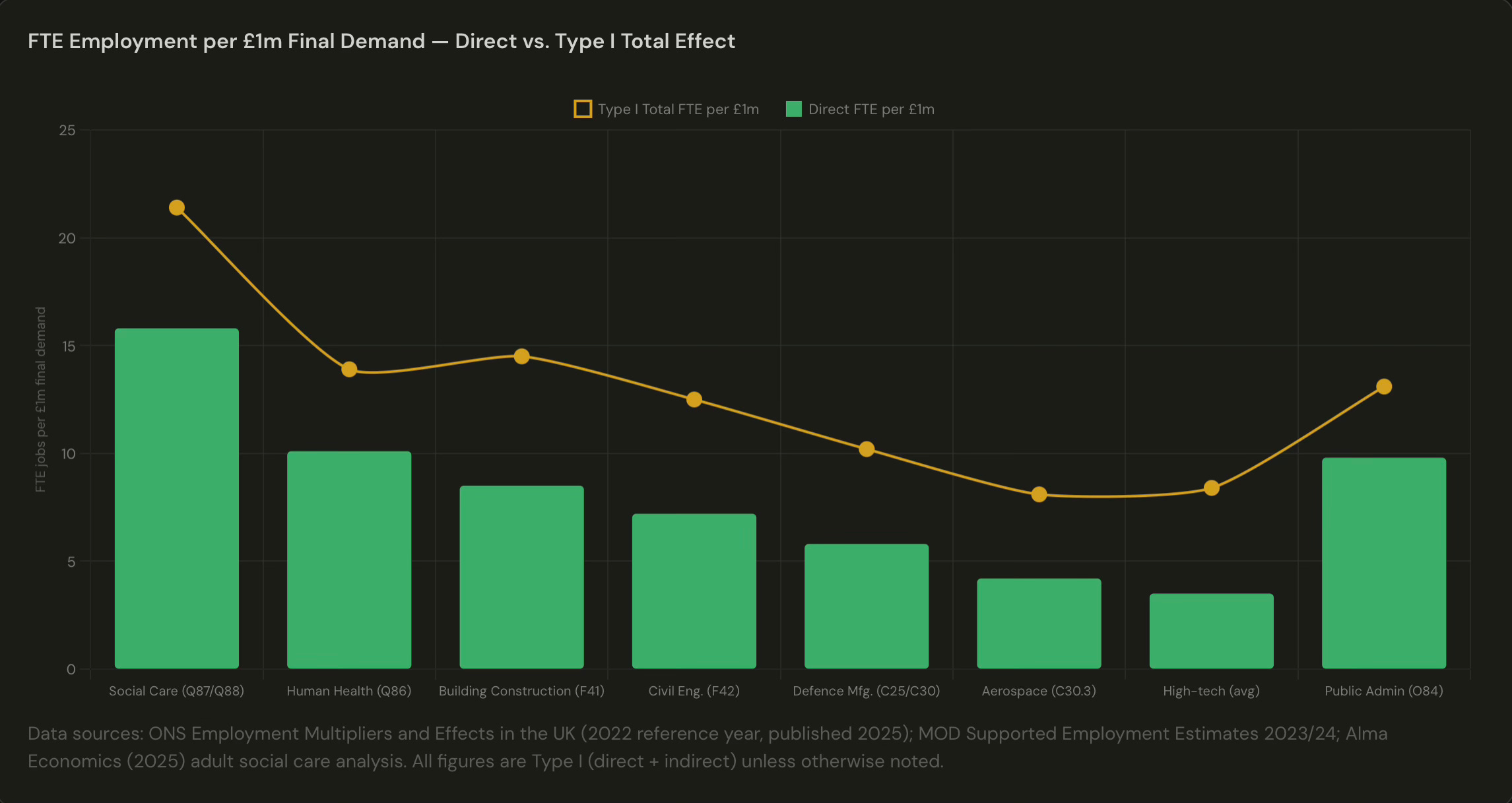
It shows Defence creates about 5 direct jobs for every £ million spent and 10 once you include indirect job creation. Low paid and insecure sectors achieve much higher job creation.
For reasons known only to Whitehall, the MOD did not use these estimates to come up with its 60,000 figure, but instead:
They took the baseline “jobs created per £1 of MOD spend” figure from 2023/4 (the latest available),
applied productivity and inflation deflators,
assumed the amount of MOD budget spent in Britain remains constant to 2029,
and did the math….
Significantly, they calculated jobs from total MOD spend, not the capex spend that most of the DIP money will go on, and from which most of the other Departments lost out.
The MOD methodology is outlined here.
The Transition Security Project did something completely different. They divided the MOD’s claim of 60,000 jobs created by £25bn, to calculate that each million pounds spent creates just 2.4 jobs. Then they estimated – correctly – that capex spent on building railways and grid infrastructure might create more than that.
But… the DIP cost £15bn, not £25bn, so where did the £25bn divisor come from? The answer is they seem to have included all the extra money allocated to Defence since Labour took power.
But the DIP claims that “this new investment plan” is what produces the extra jobs, not the money already spent. So we’re already looking at mismatched claims.
In addition, the TSP authors focused on capex alone, while the MOD figure is based on total spend including services like maintenance.
If they’d mirrored the MOD’s method, the TSP would have to accept that the extra £15bn creates at least 4.0 jobs per £ million spent, not 2.4.
They are right that spending money elsewhere would probably create more jobs. If you spend a million pounds on free school meals it might create ten school meal attendant jobs, while if you spend it at a missile factory it might create four, or even two.
But in addition to creating new jobs, increased Defence spending creates economic value - something the TSP investigation forgot to investigate.
The Defence Multipliers
Multiplier effects from Defence spending are one of the most contested issues in economics. But there is good evidence that they are greater than 1:1.
In the run up to the election, Labour’s Defence team drew on a consultancy report from Bain & Co. It showed that the multiplier for UK Defence spending is 1:2.2. For every billion spent in Defence, you get £2.2bn of gross output.
Other multipliers are available, and all analysts acknowledge that the final outcome depends on the successful execution of industrial strategies across the board, on regional effects and third order spillovers.
But if we look at GVA and productivity, not simply jobs created, the picture becomes a lot more positive. The y-axis of this chart, from the Bain & Co research, shows that Defence spending has a higher multiplier effect than general manufacturing, and the y-axis shows that the average productivity of its workforce is way higher than in construction and transport (where the TSP want to spend the money):
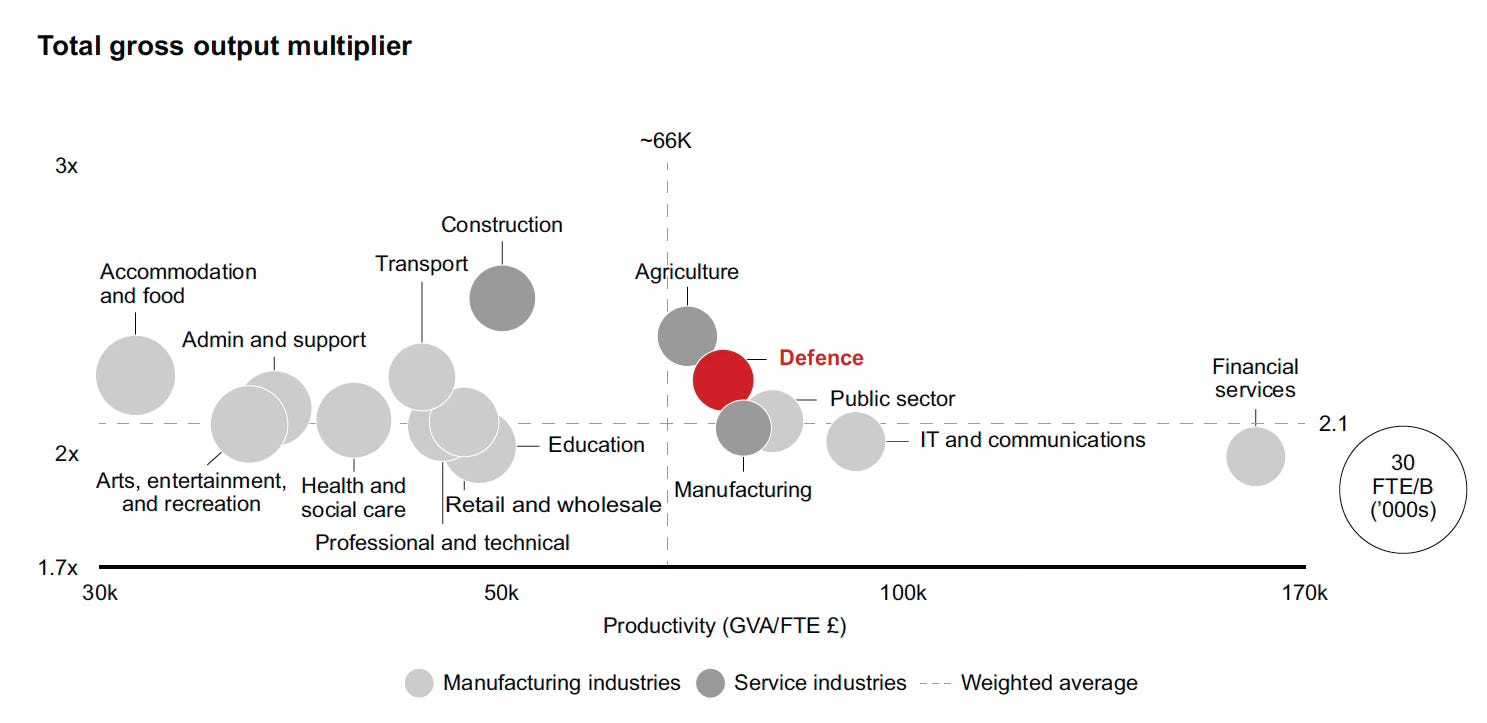
That is because Defence jobs are among the highest paid in manufacturing. The MOD’s figures show that the average Defence job pays £57k, compared to around £38k across the rest of manufacturing.
Plus - again escaping the notice of our investigators - Defence has some of the highest unionisation rates in the private sector and (thanks to Labour) the unions now sit on the Defence Industrial Joint Council with the bosses of BAE and Lockheed Martin, on equal terms.
While we’re on the subject, 21% of the Defence workforce is female. And while that leaves a lot of room for improvement, it is 6 percentage points ahead of construction as a whole, while the on-site construction workforce is just 1% female.
The point here should be clear. Even if Defence spending creates fewer jobs than money spent on energy and transport (say 5 jobs compared to 9): (a) the economic impact is likely greater; (b) the socio-political impact might is probably higher and; (c) we might not care, because at the end of the day Defence, like clean energy and transport, is a public good.
Ultimately we spend on healthcare because we need hospitals, not jobs. The same argument goes for defence.
The left neoliberals
Let us look at the wider arguments against Defence spending in the TSP report. It states:
“The loss of economic infrastructure — such as regional transport networks or energy investments that reduce bills — will not be replaced by spending on weapons programmes that do not provide wider value to the economy beyond employment.”
This is an argument borrowed straight from neoliberal economics, which often treats Defence as luxury spending.
For me, living in a country that cannot be conquered due to possessing a strategic nuclear weapon would fit my definition of “wider value”.
So would generating intellectual property, AI sovereignty, a dense network of university research labs - plus the intangible goodwill and strategic advantage that allows the British state to shape the world around us.
So would having a workforce with secure jobs, a track record of promoting women into skilled tasks, trade union recognition and some of the highest wages in Britain.
The authors, in short, do not seem to recognise that security, defence and resilience, and the intellectual property they generate, are public goods - on which our critical national infrastructure, democratic freedom, trade position etc depend.
In making their case against Defence investment, the authors also ignore the work done by Labour to transform Defence. For example, they claim that:
“The recent growth in European military spending now supports nearly 200,000 jobs in the US due to the billions spent by European governments on weapons imports. The UK is a core contributor to this, with 85 per cent of its weapons imports coming from the US. Widespread spending on weapons imports maybe one reason that military spending has such a poor jobs multiplier.”
But the entire premise of Labour’s Defence Industrial Strategy is to “Build in Britain” – that’s why the DIP allocated a massive £6bn to the GCAP stealth bomber programme with Italy and Japan – whose purpose is to wean the UK off US-produced combat aircraft.
And it is why the MOD’s assumption – of a steady 53% of the Defence budget spent domestically – is probably too negative by the time we get to 2030.
In addition, the TSP authors ignore Labour’s proposal for an Offset Scheme, whereby foreign companies winning UK defence contracts will be obliged to create economic value in the UK to a standard % of the contract value - a kind of tax on offshoring.
The purpose their muddled maths and faulty assumptions becomes clear once they outline their wider objections to Defence spending: it is unnecessary because it supports the aims of “a persistent military footprint in the Middle East”, a “persistent military presence in the Indo-Pacific”, a “persistent forward presence in Latin America and the Caribbean”, plus military engagement in the Caucasus, Africa and Moldova.
If you are going to object to these commitments, fine: they amount to less than a quarter of a billion pounds.
But please don’t try and say that such spending on global reach is “wasteful”. Because you just cannot know.
You cannot know whether the two small Offshore Patrol Vessels the Royal Navy has stationed in South-East Asia are, economically, worth their weight in gold or guano. Because, again, the value of military presence in the Pacific cannot be calculated on the neoliberal matrix of “value for money”.
The authors make the point that there is about £1.5bn of fraud risk and an equivalent amount in written off contracts in the MOD accounts. That is lamentable. It the legacy of 14 years of Tory government. Labour’s intent is to clean it up. But it is not an argument for refusing to rearm.
They also point out that the UK’S nuclear deterrent is £3.7bn more expensive than the French. But there are good and bad arguments contained in that objection.
The French practise defence dirigisme: they buy domestically from a substantially state-owned industry – all of which makes their deterrent cheaper. I, too, would prefer some dirigisme and state ownership here at home.
But the French nuclear posture is framed around the concept of a “warning shot” which the UK does not subscribe to: our deterrent is for strategic use only – a second strike capability designed to deter Russia from a nuclear attack. They are two different capabilities.
In addition, the UK nuclear deterrent is assigned to NATO and the French one is not.
So we are not comparing like with like. The only way we’ll ever find out whether the £3.7bn discrepancy is a good thing or a bad thing is if we ever have to wage a nuclear war. Personally I would prefer a nuclear weapon that is expensive and achieves deterrence to one that is cheap and might not.
The least defensible statement in the TSP report is this:
“The Ministry of Defence has forced through cuts that harm the everyday security of citizens and reduce the UK’s resilience”.
Hold on! The DIP funds a strategic investment in 6G combat air; it switches the navy from crewed ships towards uncrewed ones, putting fewer sailors’ lives at risk; it puts £1.6bn into AI and quantum computing – where losing the race with China could have catastrophic rather than incremental outcomes. It will create a substantial stockpile of munitions and fund a new lab to protect the UK against biological threats that are proliferating from the CRINK countries.
All of these are, again, public goods that cannot be contained either in raw jobs or GVA figures.
So it is not proven that the DIP “harms the everyday security of UK citizens”. In fact, it massively enhances it. And once Andy Burnham’s resilience agenda kicks in, it will enhance it further.
Regional inequality
There’s one more argument in the TSP report that deserves addressing:
“Military spending is also a poor solution to regional inequality as more than half of it goes to the south of England and London”.
Actually London is not a huge per capita recipient of Defence spending: the £3bn a year it gets amounts to £320 per head of population – around the same as the East Midlands. What’s true is that South West and South East England get around £7bn each because that is where the Royal Navy is based.
But Defence spending is also a massive regional success story for the North West, where nuclear submarines and a large amount of aerospace is built. As a result, if you divide the impact of defence spending by the number of jobs created – which is where we started out – the standout winner is …. Andy Burnham’s home region:
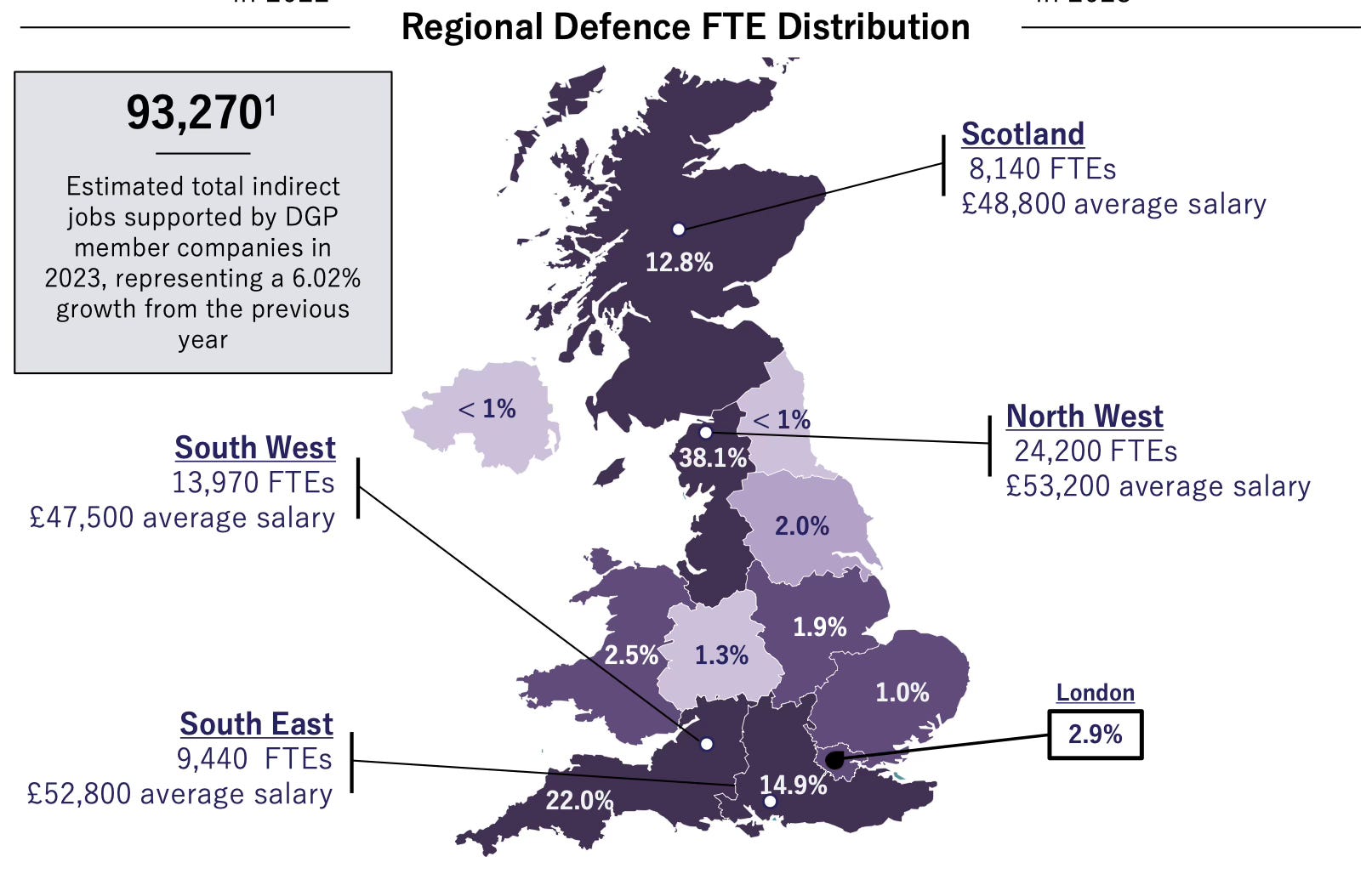
But because Labour has identified areas in deficit - like Wales and Tyneside - it has made a big play of remedying that.
The whole point of the DIP, alongside Labour’s Defence Industrial Strategy – which I helped author while in opposition - is to spread the investment across the regions.
Pursue the synergies, not the conflicts
The TSP report speaks to an important sub-theme that is emerging as Labour moves into Burnham era. Andy Burnham, writing in the Times, rightly emphasises the resilience agenda alongside hard military power.
I’ve written elsewhere that his work on resilience after the Manchester Arena bombing will allow his administration to bring new dynamism to that agenda – sorely needed given the shaky state of the UK’s privatised energy and water infrastructure.
What we cannot have is a debate that says “resilience versus defence”. The two have to work in synergy, as they do via Article 3 and Article V of the North Atlantic Treaty.
As we leave neoliberalism behind, we have to learn to conceive the inputs and outputs of public spending in human terms, not sheer value for money metrics.
Achieving Net Zero and enhanced energy security, and deterring Russia from attacking ourselves and NATO allies, are twin objectives vital to the human security of the UK population.
Deterrence costs money, and it is clear that the new government will retain Labour’s commitment to spend 3.5% of GDP on Defence. We need to find the maximum synergies between the Net Zero/energy security objectives and the hard Defence imperative.
To do that, we should reject poorly evidenced claims about Defence production undermining the security of the population and “causing unemployment”.
Thanks for reading. I’m feeling public spirited today, so this is unpaywalled. Back to the exclusive content next week. Here’s my latest at The New World. Please share and subscribe.
Why is defence so difficult? The frontline in the Ukraine is 20 Kilometres apart and nothing moves that is no known to the other side. If Russia attempts to invade any of the Baltic states or Poland the same parameters apply. Russia is not going to risk nuclear oblivion for additional land it held for 45 years without once feeling it was welcome. We have the opportunity to practice all our strategies in the Ukraine by simply supplying second line staff at operational level and gaining first hand knowledge of the use of drone attack and surveillance. I know we help train their raw recruits but our senior NCO’s and junior officers could easily learn first hand the successful methods being employed by the Ukrainians.