
Tulsi and the Trotskyists
As Zelensky flies to Mar-a-Lago, MAGA and Britain's far left simultaneously designate Europe the aggressor. What's going on?

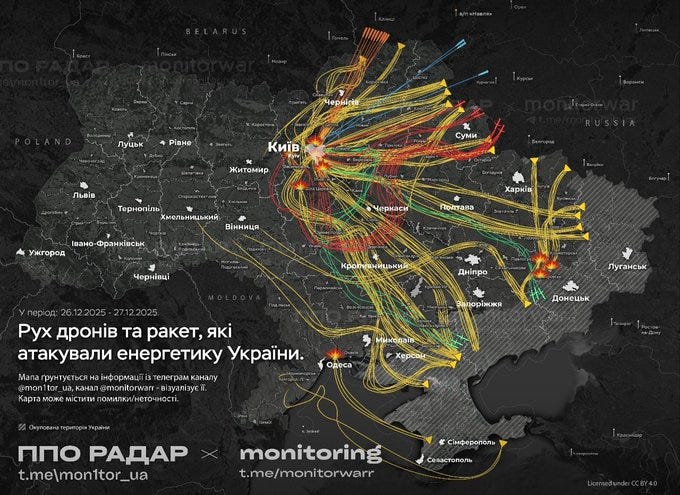
The background music to the Trump-Zelensky meeting at Mar-a-Lago was ominous ominous: two nights ago Russia carried out a mega-strike, hitting civilian homes and energy plants, leaving one third of Kyiv without power.
And Russia has hit civilian ships in the port of Odesa and tried to cut off road access to SW Ukraine from Romania through strikes on transport infrastructure.
It feels like a non-nuclear version of “escalate to de-escalate”: attacking Ukraine throughout the depths of its infrastructure to signal to the West what comes if it does not force Kyiv into semi-surrender.
But the worst thing is the cognitive warfare being practised within the Trump administration targeted at weakening NATO’s resolve to back Ukraine to the point of victory:
Trump’s National Security Strategy peddled the myth that Europe is the aggressor in the Ukraine conflict.
Just before Christmas, the USA sanctioned five European citizens, two of them Brits, for their work exposing far right disinformation and enforcing European counter-hate speech law.
Simultaneously the US Director of National Intelligence – and long-time Assad apologist – Tulsi Gabbard upped the ante by claiming the USA has no intelligence suggesting Russia intends to attack a European NATO member.
Gabbard’s tweets came after six US intelligence sources briefed Reuters that, contrary to White House claims, “Vladimir Putin has not abandoned his aims of capturing all of Ukraine and reclaiming parts of Europe that belonged to the former Soviet empire”.
Gabbard’s furous response is worth quoting in full":
“No, this is a lie and propaganda @Reuters is willingly pushing on behalf of warmongers who want to undermine President Trump’s tireless efforts to end this bloody war that has resulted in more than a million casualties on both sides.
Dangerously, you are promoting this false narrative to block President Trump’s peace effort, and fomenting hysteria and fear among the people to get them to support the escalation of war, which is what NATO and the EU really want in order to pull the United States military directly into war with Russia.
The truth is the US intelligence community has briefed policymakers, including the Democrat HPSCI member quoted by Reuters, that US Intelligence assesses that Russia seeks to avoid a larger war with NATO. It also assesses that, as the last few years have shown, Russia’s battlefield performance indicates it does not currently have the capability to conquer and occupy all of Ukraine, let alone Europe.”


First note the deeply alarming language: NATO and the EU are etherised – just as in the NSS: as if the USA is not part of NATO, and in fact the traditionally commanding power.
Second, NATO and the EU are characterised as aggressors – perfectly fitting the Kremlin narrative and those of its proxies (see below).
Third, for someone whose job title includes the word “intelligence” Gabbard’s reasoning is epically dumb.
Because the Reuters claim is not that “Putin seeks a larger war with NATO” or that the Russian military has the capability to conquer and occupy all of Ukraine and Europe.
Its claim, to the contrary, is that – as per the December 2021 Draft Treaties, Putin wants to demilitarise and neutralise Eastern Europe, pushing NATO back to its 1994 borders, and to turn Ukraine into a vassal or at least demilitarised and neutral state.
[If Dir. Gabbard wants to disprove that, she could declassify the intelligence that does so. However, numerous European states believe otherwise because, despite underspending on defence we can do ELINT and SIGINT.]
Why do I call this cognitive warfare - or at the very least “running cognitive interference”? Because Gabbard’s argument is a direct echo of what parts of the Western extreme left have been arguing, which in turn reflects a classic Kremlin talking point.
Enter the Leninists
If you’re a member of the Leninist re-enactment community, December 2025 is a confusing time to be alive. Suddenly the White House is echoing arguments you have been valiantly making on Putin’s behalf for four years, calling NATO and the European Union warmongers and cosying up to the fascist in the Kremlin.
In this issue of Conflict & Democracy I am going to deconstruct an article from Counterfire, whose leaders run the Stop The War movement and recently participated in the Leninist takeover of the Your Party conference – because it makes the same argument as Gabbard - and at least tries to argue from evidence rather than hunch.
It’s an important argument to refute -because you’re also likely to hear it from averagely-engaged and well intentioned pacifist teenagers. It asserts that: Putin can’t invade Poland because he can’t even take Ukraine after four years of trying.
Citing numerous European officials and politicians, who have warned their countries to be ready for Russian aggression, Counterfire argues:
“The language of an omnipresent frontline and the prospect of British blood being spilled in the future is designed to create an atmosphere of national insecurity. As a narrative with very little in common with material reality, it functions as consensus-building for a more hawkish foreign policy and increased military spending.”
That displays scant understanding of the nature of the Russian threat – of hybrid and cognitive warfare, of the nuclear escalation ladder, and of the way (cf both Marx and Hegel) quantity has a habit of turning quality in conflicts like this.
Se let’s take Counterfire’s claims one by one:
Claim 1: The Russian economy is much smaller than the EU or NATO’s economies combined, therefore it cannot be regarded as a peer military competitor.
The premise is true: Russia’s GDP is many times smaller than Europe’s. However, that does not make Russia a non-peer competitor in military terms. Russia has an economy mobilised for war, a population desensitised to war, and is predicted to have spent 7.5% of its GDP on defence this year – which is 41% of state expenditure.
When we use Purchasing Power Parity (PPP) – what you get for what you spend – it becomes clear that Russia is already outspending the whole of Europe on defence.
That is the very definition of a peer adversary, before we even consider the specifics which are:
Russia is a unified state, with a single military; European NATO is an alliance of 30 sovereign countries who cannot even use each other’s artillery shells even when they are technically of the same calibre, and whose defence procurement is notoriously fragmentary and not geared for war.
Russia’s doctrine and exercise regimen is geared for offensive action against Europe; European NATO’s doctrine is premised on US participation - it has never exercised to defend itself without US support.
The strategic enablers needed to defend Europe against Russia are largely owned by the USA: satellites, intelligence, nuclear attack sensors, heavy lift transport planes and heavy long-range bombers.
Take it from me: no European military chief thinks conventional war with Russia would be a pushover, even if the every member of NATO stepped up to the plate.
And that’s where we come to Claim #2:
“Russia lacks the ability to secure a strategic victory against Nato in any conventional scenario. After almost four years of war, the country has failed to subdue Ukraine, one of the least developed states in Europe.”
This is the same crap as peddled by Gabbard, and is easily debunked by considering what NATO’s military staff actually plan for, which is a token land grab followed by a threat to use tactical nukes.
If Russia were to seize the Estonian town of Narva by force – whose borders were never finalised after the end of the Cold War – and Estonia invoked Article V, what might realistically happen?
In the worst case scenario for Putin, every NATO member mobilises, British troops spearhead retaking the territory, Russian ships are sent to the bottom of the ocean in every hemisphere, St Petersburg gets hit with long-range strikes and Kaliningrad involuntarily joins the West.
But in the best case for Putin, his little helpers inside NATO prevent a unified response. NATO is paralysed. Article V is exposed as a myth.
In that scenario, Russia not only gets to keep Narva, but demonstrates to every NATO member that the Alliance is useless.
At that point – as with Hitler’s march into the rump of Czechoslovakia in March 1939 – the entire security order of the world gets rewritten. China probably seizes Taiwan; and Ukraine is demonstrably on its own.
You could substitute for Narva the Suwalki corridor of Lithuania, or the demilitarised Norwegian island of Svalbard, or Sweden’s Gotland, or the Åland Islands.
The geostrategic impact would be the same: the functional end of NATO.
So the claim that “Russia can’t win in any conventional scenario” is false (and coming from Counterfire, which advocates the dissolution of NATO, disingenuous).
But here’s the wider problem. The idea that “Putin can’t invade Poland” so we don’t need to rearm ignores the fact that war is now fought across at least five domains: land, sea, air, space and cyberspace.
Putin’s ships and submarines can legitimately sail to within 12 miles of the UK without asking anyone’s permission, and over Christmas his nuclear-capable bombers performed one of their regular, ritualised dummy bombing runs against the UK. Meanwhile the cyber attack on Jaguar Land Rover this year, costing the UK government £1.5bn just to get a single production line up and running, could happen to the whole NHS if Putin’s cyber-criminals get lucky.
Ignoring 5-domain warfare is politically illiterate, and is to my mind a deliberate act of useful idiocy by the people making this claim. Which brings us to…
Claim 3:
“Even short of [the nuclear] threshold, any war would mean mass deaths, economic collapse and increased repression at home. These costs are borne most by people with the least power to influence decisions.”
The first part of this is true. Working class people always bear the brunt of war, as the Russian-speaking Ukrainian miners fighting on the front line in Donbas – with arms Counterfire has tried to stop arriving – might testify.
And yes, in wartime, there would be “repression” – probably starting with people who do the kind of stuff that happened in Epping in 2022.
Which is why we should all do our best to avoid such a war.
The question then is whether you think deterrence works. If you don’t - and it may be true that Putin is inured to rational pressure - you face a straight choice between appeasement and preparing to win an existential war of survival.
If you do think deterrence works - and there is strong evidence that it does - you have to find the means to make it credible.
As to “influencing decisions”, fortunately, the mass party of the working class – Labour – backed by millions of working class voters in 2024, came to power on a programme of achieving peace through deterrence: through renewing the defence industrial base, modernising the armed forces and maintaining both the nuclear deterrent and membership of NATO – all of which Counterfire/Stop the War oppose. And this decision was actually influenced by quite a lot of workers - namely the ~4 million workers represented in the TULO trade unions, all of which backed the 2024 manifesto in an actual vote.
Claim 4: Citing recent European moves towards conscription and rearmament, Counterfire claims:
“These measures represent a significant shift towards the mass mobilisation of society for war, normalising the expectation that working-class youth should be prepared to lay down their lives.”
I’ll tell you what “mass mobilisation for war” looks like: soldiers frantically handing out AK47s and magazines to civilians and delivering stockpiles of bottled water to kids building firing positions in their council estates - as happened in Kyiv in February 2022.
If they were really “mass mobilising society for war” European states would do what they did in 1914 and 1939. But no European state is doing so. So the claim is hyperbole.
What they are doing is sensibly expanding their options for creating reserve forces, and starting to educate people about what a Russian attack would mean. Some of the most social democratic and welfarist societies – Finland, Sweden and Norway – have big reserves already. But others have for good reason shied away from employing reserves.
But here’s where Counterfire have a point. If Putin attacks a European country, and we honour our 7-decade commitment to mutual self-defence, working class people would be called upon to fight. And the question is: should we?
Lenin or Bevan?
If you take the Leninist position, that in all wars the defeat of your own country is better than its victory, because defeat is the surest route to civil war, then being called upon to defend the country will be an affront to your principles.
But even Lenin could not sell that idea to the Bolshevik Party in 1917, just as he had failed to sell it to the Zimmerwald socialist peace conference two years earlier. And if Russia cyber-attacked the NHS, the transport system and the energy supply, I doubt Counterfire would get many takers for “turn the war into a civil war” in Britain.
Would “working class people” really sit back and let their opposites – “upper class people” – fight a war of existential self defence against Russian aggression. Does Counterfire think that would somehow enhance the reputation of socialism, or of the working class, or enable the labour movement to shape the peace as we did in 1945?
In the anti-fascist wars of the 1930s and 40s, workers were the first into the front line – because they knew they had the most to lose, both from fascism and from failing to prevent escalation into global conflict.
But Counterfire can’t bring themselves to promote full-scale Leninism within Your Party, opting instead to promote a resolution passed by… wait for it… the 1907 Stuttgart Congress of the Socialist International:
“A historical guide for such resistance comes from the anti-war resolution adopted at the Second International in Stuttgart in 1907, where socialists committed to ‘exert every effort in order to prevent the outbreak of war’, and, should war occur, to ‘intervene in favor of its speedy termination’.”
Actually the mealy-mouthed Stuttgart Resolution proved about as useful as the proverbial marshmallow fireguard in 1914 – and was a dead letter by 1936 when the Spanish Civil War broke out. By this time the French Communist Party was marching behind the tricolour and singing the Marseillaise, and the CPGB was recruiting working class people to the International Brigades.
It is also analytically lazy to hark back to the pre-1914 Second International. The Stuttgart Congress identified the cause of war as “competition within the world market” and as a result of “the incessant race for armaments by militarism”.
Can anyone seriously look at European societies today and accuse them of an incessant race for armaments – while most are spending way below 2.5% of GDP on defence?
And can anyone seriously claim the wars in Gaza, or Yemen, Sudan, or India vs Pakistan can be traced back to “competition within the world market” - ie the struggle for colonial possessions of the kind that drove the Great Powers into armed conflict in 1914?
Nope: the causes of the wars of the past 30 years are multiple, but come down to post-Cold War disintegration (Yugoslavia, Nagorno, Moldova), American desire for unipolar hegemony (Iraq 1&2 plus Afghanistan), Russian ethno-nationalism (Georgia, Chechnya, Ukraine) and the fact that the emergent multipolar world is chaotic, not orderly.
But there is one military power that conforms to the classic Leninist template for ethno-nationalist, militarist colonialism: Russia. The one state the tankies never dare to criticise.
Doesn’t the rise of Russian ethnonationalist aggression, and of a MAGA administration prepared to do deals with Putin while sacrificing European security, mean that we in Europe are at great peril, and need to rearm - even to preserve the freedoms to organise and associate that are banned in Russia and Belarus? That is the question Counterfire has to sidestep.
The Russian threat
This is a dangerous world – in which having a small, professionalised and socially separate armed forces, and a defence industry largely privatised, is not enough to ensure national security and resilience:
Russia outmatches Europe in nuclear weapons (and let’s remember people like Counterfire/Stop the War want us to give them up).
Russia has a mobilised economy and conventional armed force that is more than adequate for the task of an land-grab attack designed to break NATO diplomatically.
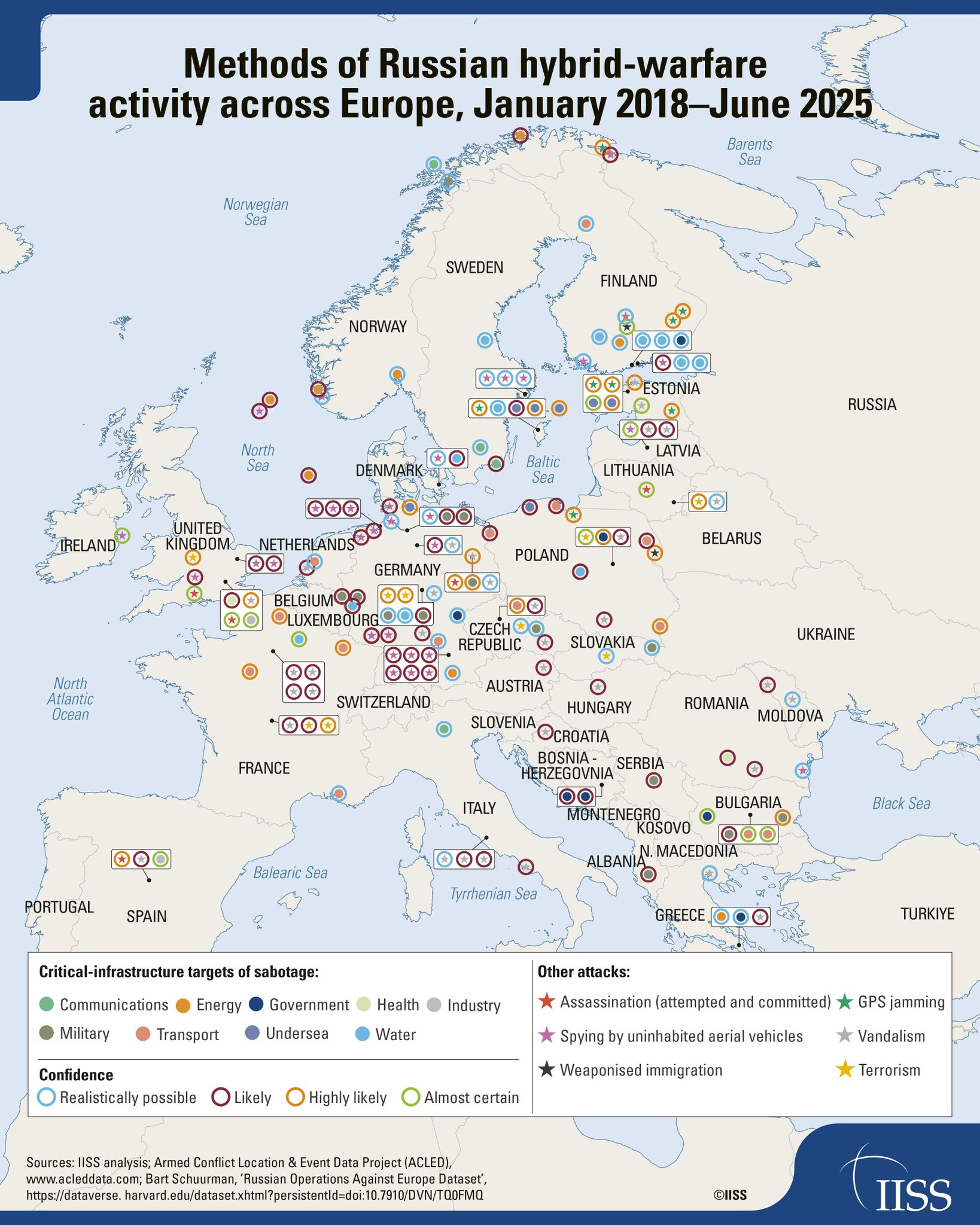
In addition, Russia is launching wave after wave of hybrid aggression against the UK and its European allies. This map, from IISS, summarises what’s happening: drone disruption of civil airspace, attacks on undersea cables, cyber attacks on major institutions and targeted assassinations on European soil.
Instead of an archaic resolution from the era of Virginia Woolf, I suggest people on the left of British politics start reading relevant stuff – like this short summary of Russian New Generation Warfare, which lists the tactics to be used against the “state victim” (i.e. ourselves).
Put that on the agenda of the next day school and ask yourselves, ever so politely, whether you are taking sufficient care not to be used as proxies in such an endeavour.
Or maybe just read the UK’s own National Security Strategy, compiled under meticulous scrutiny and challenge from academics, think tanks and civil servants with access to intelligence?
Opportunities for the left
Stop the War has appalling form in predicting the Russian course of action. In late 2021 and early 2022 it staged numerous online forums where figures like the academic Richard Sakwa claimed it was impossible that Russia would attack Ukraine, and that warnings to the contrary were the product of “NATO aggression”. Today they’re repeating the mistake.
If, like me, you see the abandonment of Europe and betrayal of Ukraine by Trump’s America as huge threats to our way of life and our security, you should be thinking not in terms of “resisting militarism” – but of democratising the military and security apparatus, making it accountable to society, more representative of the real Britain, funding it properly and placing the defence industry under state direction and control.
There are massive opportunities for the labour movement during rearmament – in terms of economic growth, jobs, enhanced social cohesion, public ownership and even the basic fiscal stability that underpins our welfare state.
Defence and national security is also an area of policy where Reform are on weak ground - having a leading lawmaker who took money from Putin, and having made numerous statements supporting Putin’s foreign policy arguments. Tommy Robinson, for the fascist right, has stated flatly that he would not fight for this country, polluted as it is by multiple ethnicities and religions.
If the trade unions and the left were to engage positively with the emerging debate about how we rearm this country, and make our society resilient to anti-democratic threats, we could make a genuine, positive and original contribution - and sideline the right.
Instead I see people simply echoing the arguments of Putin and his MAGA trolls, or simply hiding behind pacifist assumptions that are no longer valid.
I am on record as preferring a large, permanent reserve, composed of volunteers who retain (unlike professional soldiers) their political rights, whose units are rooted in the communities they would defend in wartime, and where trade unions are recognised as legitimate contributors to national resilience and security.
If you want to know what such reserve units might look like, take a look at the Ukrainian miners union and its brigade fighting in Donbas right now, in the snow, tonight, as you are reading this. And since it’s Christmas, maybe give them some cash…

Thank you for reading - please subscribe and share. This one is free to read. More paywalled stuff upcoming on GCAP and FCAS early in the new year…
Incredible. One of the best essays I've read on Substack.
There are many, many people who really need to check this out.